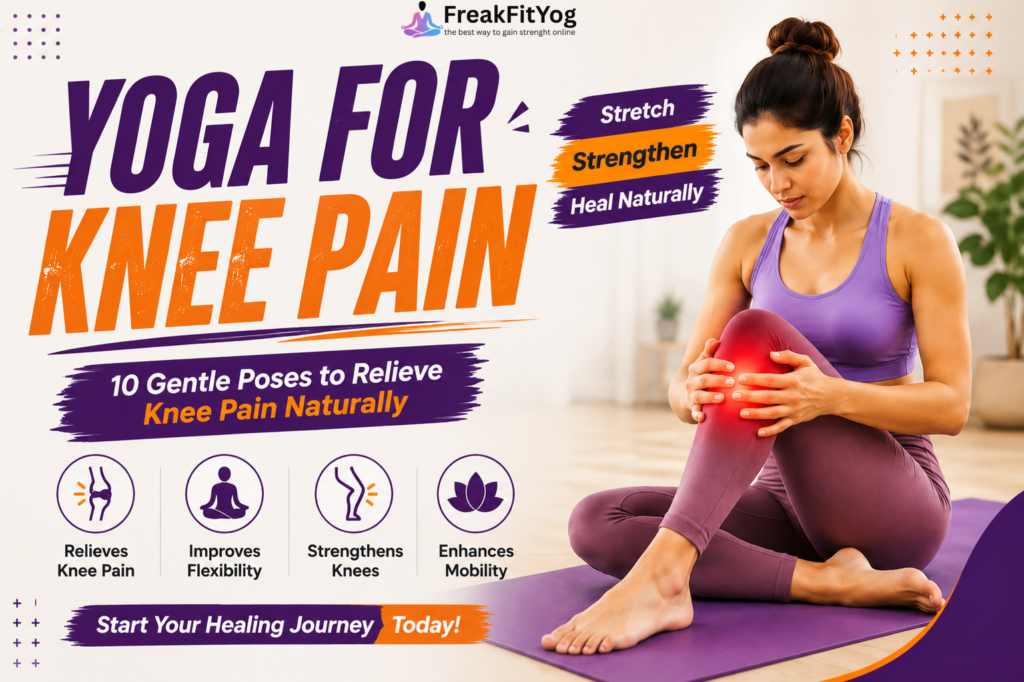
Yoga for Knee Pain: 10 Gentle Poses to Relieve Knee Pain Naturally
You don't have to "just live with it." A soft, guided practice can bring your knees — and your everyday freedom — back.
Do your knees creak when you climb the stairs? Do you wince every time you stand up after sitting too long? If you've skipped a walk, avoided a family trek, or sat out of a game with friends because your knees just couldn't take it — you're not alone, and you're not "too far gone" to fix it.
Knee pain has a sneaky way of shrinking your world. It stops you from playing with your kids or sitting cross-legged during a puja. Most people just accept it and pop a painkiller. But your knees aren't broken — in most cases they're just weak, stiff, or inflamed, and that can be gently, naturally reversed. This is exactly where yoga for knee pain comes in.
Unlike high-impact workouts that aggravate sensitive joints, yoga works with your body, not against it. It builds strength around the knee, improves flexibility, and reduces inflammation — all without the jarring impact of running or heavy weightlifting. Below are the best yoga poses for knee pain, plus how FreakfitYog can guide you through every one of them safely.
Why FreakfitYog Is Your Best Starting Point
Most online yoga tutorials are generic. A 25-year-old flexible influencer doing a pose is not the same as a 45-year-old with knee arthritis attempting it unsupervised — wrong alignment can do more harm than good.
This is exactly why FreakfitYog exists. At freakfityog.com we build personalized yoga programs around real bodies with real limitations — including knee pain, stiff joints, and post-injury recovery. Our certified trainers watch your form and modify poses so you heal instead of hurt.
Whether you're brand new to the mat or someone who used to be active but got sidelined by knee pain, FreakfitYog builds a plan specifically for you.
What Is a Fat Loss Transformation — and Why It Matters for Your Knees
A real fat loss transformation isn't just about looking good in photos — it's about reducing the daily mechanical load your knees carry. Every extra kilogram of body weight adds roughly 4kg of pressure on your knees while walking, and even more on stairs.
A genuine transformation combines gentle movement, better nutrition, and consistency — not crash diets or punishing HIIT that batters your joints further. This is precisely FreakfitYog's philosophy: helping you manage weight and knee pain together, not as two separate battles. Gentle yoga reduces pain enough for you to move more, and moving more supports fat loss — which further reduces knee strain. It's a positive cycle.
10 Best Yoga Poses for Knee Pain Relief
Warm up for 3–5 minutes before starting. Mild discomfort is normal; sharp, stabbing pain is your body's stop sign — ease off immediately.
Supported Mountain Pose
Stand tall, feet hip-width apart, holding a wall for balance. Teaches proper alignment that reduces knee pressure in every pose that follows.
Wall Chair Pose
Back against a wall, bend knees just a few inches. Strengthens the quads — your knees' natural shock absorbers — with zero strain.
Reclined Leg Stretch
Lying down, loop a strap around one foot and straighten it upward. Loosens tight hamstrings and calves with zero weight on the joint.
Bridge Pose
Lift your hips off the floor with knees bent. Strengthens glutes and hamstrings, improving knee tracking and reducing wobble.
Supported Warrior II
Wide stance, front knee bent only slightly — never past the ankle. Builds surrounding strength without a deep bend.
Cat-Cow Stretch
On all fours, alternate arching and rounding your spine. Improves lower-body circulation and eases stiffness that radiates to the knees.
Reclining Bound Angle
Soles of feet together, knees falling open (pillows under thighs if needed). Releases tension around the knee with no weight-bearing stress.
Half Locust Pose
Lying on your stomach, lift one straight leg gently. Strengthens the lower back and hamstrings that support your knees.
Seated Forward Fold
Knees slightly bent, fold gently from the hips. A gentler option when tight hamstrings pull painfully on straight-leg folds.
Legs-Up-The-Wall
Legs resting up a wall. Improves circulation, reduces swelling, and is the perfect calming way to end your practice.
Practicing consistently, even 15–20 minutes a day, is one of the most effective natural ways to manage joint discomfort. This is the exact sequence style FreakfitYog trainers use with clients dealing with chronic knee issues — always adjusted to your specific pain points.
Benefits of Practicing Yoga for Knee Pain
Builds Strength Without Impact
Strengthens quads, hamstrings, and glutes through controlled movement — meaning less pressure on the cartilage and ligaments over time.
Improves Flexibility & Range of Motion
Loosens tight hamstrings, calves, and hip flexors so your knee joint moves more naturally, with less pain.
Reduces Inflammation Naturally
Mindful movement and deep breathing lower stress hormones and systemic inflammation — a major driver of chronic knee pain.
Supports Better Posture & Alignment
Retrains your body to move correctly, addressing root causes like weak core muscles and misaligned hips.
Aids Sustainable Fat Loss
Supports a genuine fat loss transformation, gradually easing the mechanical burden on your joints.
Enhances Mental Wellbeing
Breathing techniques calm the nervous system, which can change how intensely you perceive pain.
It's Sustainable Long-Term
No expensive equipment, no high-impact strain — just a mat and guidance from a program like FreakfitYog.
How to Get Started
Get a Basic Assessment
Understand what's actually causing your pain — weakness, tightness, an old injury, or arthritis. FreakfitYog offers guided assessments so your plan fits your issue.
Start With 2–3 Poses a Day
Don't attempt all 10 on day one. Build up slowly over a couple of weeks.
Invest in Basic Props
A mat, a couple of cushions, and a strap make a huge difference for supported poses early on.
Join a Guided Program
Alone from YouTube, small alignment errors can worsen knee pain over months. A structured plan from freakfityog.com gives real-time feedback and evolves as you get stronger.
Track Small Wins
Note improvements — easier stairs, sitting cross-legged longer, walking further pain-free.
Tips to Stay Consistent
Doing yoga once won't fix your knee pain. It's consistency that heals, not a single perfect session.
⏰ Set a Fixed Time
Practicing at the same time daily builds a habit loop your brain doesn't have to think about.
🌱 Start Ridiculously Small
10 minutes daily beats an ambitious 45-minute plan you abandon in 3 days.
📓 Track Pain, Not Attendance
Watching a pain score drop from 7 to 4 over a month is deeply motivating.
🤝 Join a Community
FreakfitYog's group sessions make it far easier to stay accountable.
💛 Be Kind on Bad Days
Do a gentler version instead of skipping — even 5 minutes of legs-up-the-wall counts.
🏆 Celebrate Non-Scale Wins
Sitting through a movie without stiffness matters as much as any number on a scale.
Frequently Asked Questions
Yes — yoga genuinely helps when done correctly. It strengthens the muscles around the knee, improves flexibility, and reduces inflammation, addressing the root causes of most everyday knee pain. Proper form and gradual progression are key, which is why guided programs like FreakfitYog work better than random videos.
Most beginners notice mild improvement — less stiffness, easier movement — within 2–3 weeks of consistent practice. More significant relief for chronic issues typically takes 6–8 weeks of regular, guided sessions.
Generally yes, but modifications are essential based on severity. A personalized assessment, like the ones offered through FreakfitYog, is important before you start.
Not much — a basic mat, a couple of cushions, and a strap or old belt are usually enough. As you progress, your FreakfitYog trainer may suggest more props based on your needs.
Ready for Pain-Free Knees?
Explore beginner-friendly, low-impact yoga programs built around your body, or message our trainers directly for a personalized plan.