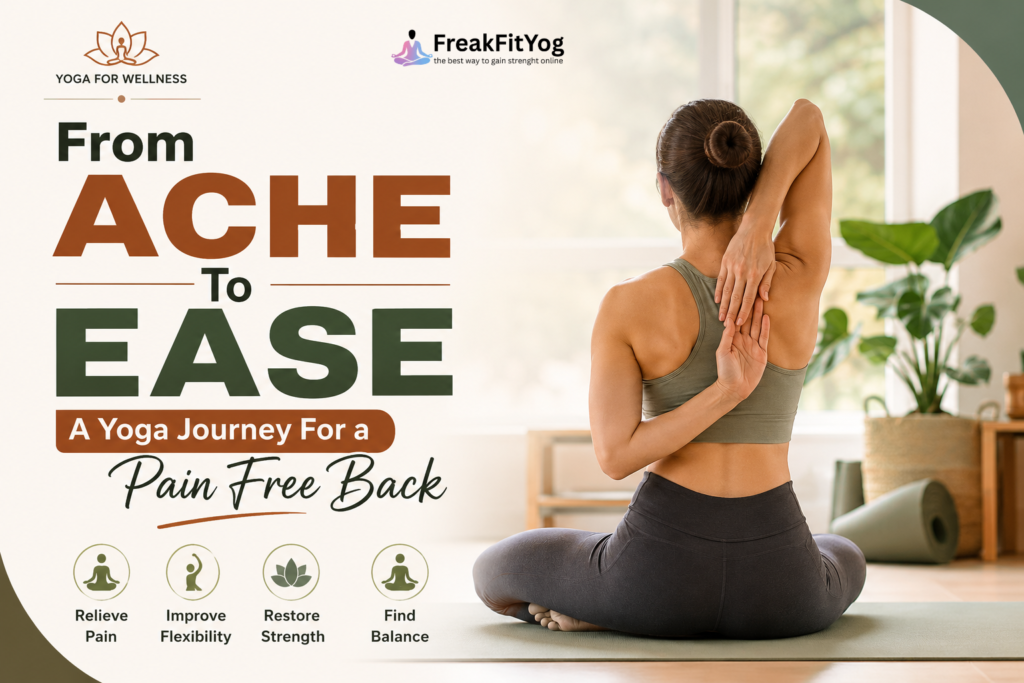
From Ache to Ease:
A Yoga Journey for a Pain-Free Back
A complete healing guide by FreakFitYog
A daily yoga practice rewires how your body holds tension — and how quickly it lets it go.
Back pain doesn't arrive loudly. It creeps in — a dull ache after a long day, a stiffness that greets you before your alarm does, a sharp catch when you reach for something on the top shelf. It is one of the world's most common complaints, and yet it is treated like an inevitable fact of life. At FreakFitYog, we refuse to accept that. Your back can heal. Your mornings can be soft and painless. And that journey begins on a yoga mat — today.
Why Your Back Hurts — and Why Yoga Works
The spine is a marvel of engineering — but it was never designed for eight hours hunched over a screen. Most chronic back pain is rooted not in structural damage, but in imbalance: tight hip flexors tugging the lumbar spine forward, weak glutes abandoning the pelvis, and a nervous system locked in a permanent low-grade state of stress that amplifies every twinge into something that feels catastrophic.
Yoga targets every one of these causes simultaneously. It lengthens what has tightened. It activates what has weakened. It decompresses the vertebrae through gentle traction. And — most powerfully — it shifts the nervous system from fight-or-flight into rest-and-restore, the only state in which deep physical healing can occur.
"The spine is the tree of life. To keep it young is to keep the whole body young — and yoga is the water that makes it flourish."
Your 5-Pose Morning Ritual for a Healthy Spine
No studio needed. No experience required. This sequence takes fifteen minutes and, done each morning, will rebuild the structural foundation your spine has been quietly craving.
Cat-Cow · Marjaryasana-Bitilasana
On all fours, alternate between arching and rounding your spine with your breath — 10 slow cycles. This wakes up every vertebral segment and flushes overnight stiffness from the lower back. The single best way to begin a pain-free day.
Child's Pose · Balasana
Sink your hips toward your heels, arms extended forward. Hold for 10 deep breaths. Creates gentle traction in the lumbar spine, releasing the compression that builds from sleeping, sitting, and standing all day. Pure, immediate relief.
Supine Twist · Supta Matsyendrasana
On your back, guide one knee across your body, opposite arm wide. Eight breaths each side. This rotational release targets the thoracic and lumbar spine, reaching the deep tension that no foam roller can touch.
Bridge Pose · Setu Bandhasana
Feet flat, knees bent — press into the earth and lift your hips. Hold five breaths, lower, repeat five times. Activates the glutes, hamstrings, and spinal extensors — the muscles most responsible for protecting your lower back all day.
Legs Up the Wall · Viparita Karani
Legs vertical against a wall, arms soft by your sides — five minutes. This gentle inversion reverses gravitational compression, calms the nervous system, and signals to your whole body that recovery is the priority right now.
Bridge Pose builds the spinal support your lower back has been quietly asking for.
The Mindset of Long-Term Healing
Yoga is not a transaction. You cannot do three sessions and expect a lifetime of pain to dissolve. But here is what you can expect: in the first week, a lightness. In the second, a different quality to your mornings. By the fourth week, the chronic ache that once defined your days will have begun to loosen its grip — slowly, undeniably, permanently.
The secret is consistency, not intensity. Five mindful minutes on a hard day outperforms a skipped session in pursuit of perfection. Let your breath set the depth of each pose. Let ease — genuine, hard-won ease — be the destination.
Over time, this practice reshapes more than your body. You stop being a person who suffers from back pain and become someone who tends to their spine with intelligence and patience. For deeper routines and expert guidance, visit FreakFitYog — your home for movement that heals.
Your Pain-Free Back
Starts Here
Guided routines, pose libraries, and expert tips — all at FreakFitYog.
Explore FreakFitYog →Keywords
Yoga for Back Pain and Sitting All Day
Long periods of sitting can make some people feel stiff, particularly around the hips, lower back, and upper back. If you work at a desk, combine your yoga practice with regular movement throughout the day.
Try to:
- Change position regularly
- Take short walking breaks
- Keep your screen at a comfortable height
- Avoid staying in one position for hours
- Practice gentle mobility exercises
- Strengthen your core and hip muscles appropriately
Yoga can complement these habits, but it should not be considered a replacement for good workplace ergonomics or appropriate medical care.
Gentle Yoga vs. Intense Yoga for Back Pain
If you are experiencing back discomfort, gentle yoga is generally a better starting point than an intense or advanced practice.
Gentle yoga emphasizes:
- Controlled movement
- Comfortable ranges of motion
- Slow breathing
- Relaxation
- Body awareness
- Gradual progression
Avoid forcing deep forward folds, aggressive twists, or advanced poses simply because they look impressive. Your practice should feel controlled and comfortable.
Can Yoga Prevent Back Pain?
Yoga may contribute to better mobility, strength, body awareness, and physical activity, all of which can support overall back health. However, no exercise program can guarantee that a person will never experience back pain.
A healthy approach combines regular movement with strength training, good posture habits, adequate recovery, healthy body weight where appropriate, and sensible daily activity.
When Should You Avoid Yoga for Back Pain?
Do not push through severe or worsening pain during yoga.
Seek professional medical advice if your back pain is persistent, severe, follows a significant injury, or is accompanied by symptoms such as weakness, numbness, or other concerning changes.
Yoga should support your health—not replace appropriate medical assessment when you need it.
Frequently Asked Questions About Yoga for Back Pain
Is yoga good for back pain?
Yoga may help some people manage back discomfort by supporting flexibility, mobility, muscle strength, relaxation, and body awareness. The right approach depends on the underlying cause of the pain, so gentle practice is a sensible starting point.
Which yoga poses are best for back pain?
Common gentle movements include Cat-Cow, Child’s Pose, Bridge Pose, and comfortable supine movements. The best poses depend on your symptoms and mobility. A pose should not cause sharp, severe, or worsening pain.
Can I do yoga every day for back pain?
Many people can include gentle yoga in their daily routine, but the intensity and duration should match their individual needs. If you are new to yoga, start gradually and allow your body to adapt.
How long should I do yoga for back pain?
Beginners can start with a short session, such as 10–15 minutes, and gradually increase the duration if it feels comfortable. Consistency is more important than forcing a long session.
Can yoga help lower back pain from sitting?
Gentle yoga may help with stiffness and mobility associated with prolonged sitting. However, regular movement breaks, appropriate workstation setup, walking, and strengthening exercises are also important.
Can beginners do yoga for back pain?
Yes, beginners can start with gentle, beginner-friendly movements. Avoid advanced poses and do not force your range of motion. If you have an existing back condition or significant pain, consult an appropriate healthcare professional before beginning a new exercise program.
Should I do yoga if my back hurts?
It depends on the cause and severity of your symptoms. Gentle movement may be appropriate for some types of back discomfort, but you should stop any exercise that makes your symptoms worse. Severe, persistent, or unusual symptoms should be evaluated by a healthcare professional.
Is morning yoga good for the back?
A gentle morning yoga routine can be a convenient way to introduce movement after sleeping. Start slowly rather than immediately performing deep stretches or demanding poses.
Can yoga replace treatment for back pain?
No. Yoga can be part of a broader movement and wellness routine, but it should not automatically replace medical evaluation, physiotherapy, medication, or other treatment recommended for a specific condition.
What should I do if a yoga pose increases my back pain?
Stop the movement and return to a comfortable position. Do not force the pose or try to stretch through sharp or worsening pain. If symptoms continue or become concerning, seek professional advice.
A Simple 15-Minute Beginner Back-Yoga Routine
If your body feels comfortable with these movements, you can structure a beginner routine like this:
1–2 minutes — Breathing and gentle mobility
Start by sitting or lying comfortably. Take slow, relaxed breaths and bring awareness to your posture.
2–4 minutes — Cat-Cow
Move slowly between spinal flexion and extension. Coordinate the movement with your breathing.
4–6 minutes — Child’s Pose
Move into a comfortable variation and avoid forcing your hips toward your heels.
6–9 minutes — Supine Twist
Lie on your back and gently rotate one leg across your body. Keep the movement within a comfortable range.
9–12 minutes — Bridge Pose
Lift the hips gently while keeping the movement controlled. Stop if the exercise causes discomfort.
12–15 minutes — Relaxation
Finish in a comfortable resting position and take slow breaths.
This routine is intended as general wellness information, not individualized medical treatment.
How to Make Your Yoga Practice More Effective
A sustainable back-care routine is about more than individual poses.
Focus on consistency
A manageable routine that you can repeat regularly is usually easier to maintain than an intense routine that you quickly abandon.
Don’t chase flexibility
You do not need to touch your toes or perform advanced poses to benefit from yoga. Work within a comfortable range of motion.
Combine mobility with strength
Back health involves more than stretching. A balanced exercise program can include mobility, strength, walking, and other forms of physical activity.
Listen to your body
Muscle effort and a gentle stretch can feel different from sharp or worsening pain. Learn to recognize the difference and modify your practice accordingly.
Progress gradually
As your confidence and mobility improve, you can gradually develop your routine rather than suddenly increasing intensity.
Key Takeaway
Yoga can be a valuable part of a healthy movement routine for people who want to improve mobility, flexibility, relaxation, and body awareness. For back discomfort, the safest approach is to start gently, practice consistently, avoid movements that aggravate symptoms, and seek professional guidance when necessary.
Your journey from discomfort to greater ease does not have to begin with an advanced pose. It can begin with one calm breath, one gentle movement, and a commitment to taking better care of your body.